What splitting wood taught me about life
- Patrick Pawling
- Oct 8, 2024
- 2 min read
Wood stoves provide more heat than you might think. You have to drop the tree or talk
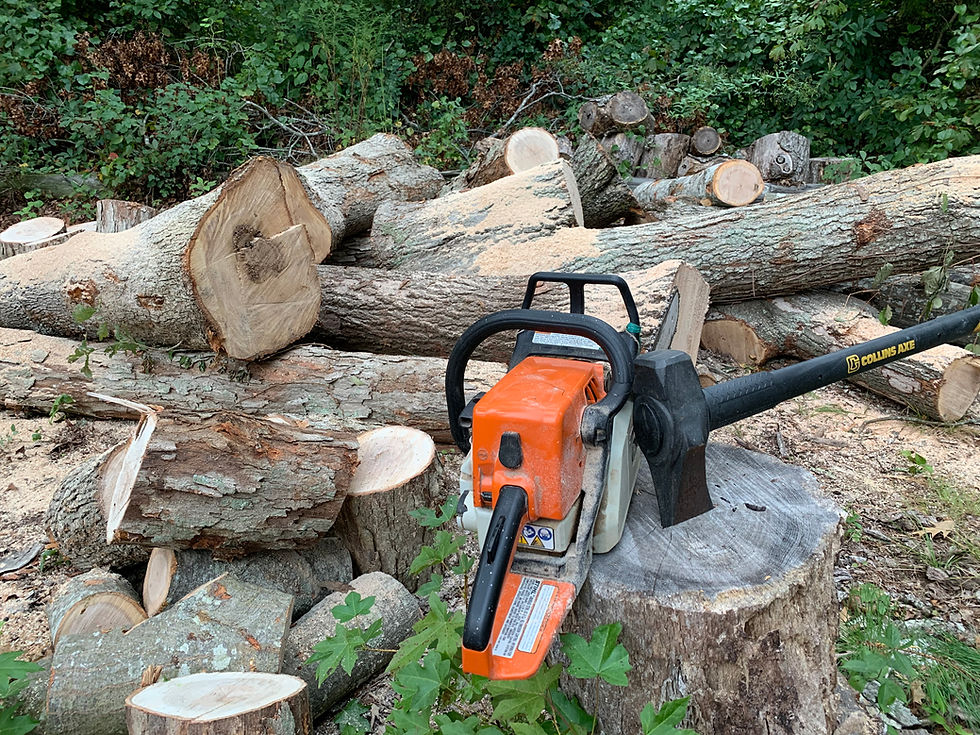
somebody into delivering some cuts, remove the branches, chain-saw everything into stove-short sections, split the sections so they fit nicely in the firebox, carry them to a place close to the house and, finally, bring them into the house when the time comes to light them. That's a lot of warmth. Sweat, even. Yes, it's a lot of trouble. I love it. The smell, sound and penetrating heat of a self-made wood fire on a cold morning, with strong coffee, a loved one and a dog, is a winter pleasure like no other, except maybe for hitting some unsuspecting person square in the back with a snowball. (Not the loved one, unless you are feeling exceptionally lucky).
Once a year I rent a mechanical splitter and go at it for a couple days. It's a fine machine: brutal, efficient, fast and no, do not rest a hand in the wrong place at the wrong time. But in between, throughout the year, I hand split. This is less efficient but equally brutal: You swing a nine-pound maul, pretty much as hard as you can, into a section of wood, hoping that it comes apart. It will not. You will need to swing again, aiming better this time, exhaling at impact, like a fighter, trying to envision the maul piercing the wood, traveling all the way through it, not stopping at the top, where it bounces off and vibrates your sore elbow in irritating ways, mocking your piddling efforts. That's the first thing splitting taught me: perseverance pays. Even the most resistant wood yields, if you bang at it hard enough and from different angles and directions. When that happens, it is very satisfying. So it is with many of the challenges I see in writing and life. Please understand, I'm not saying they all go away or are solved with continual banging, but it helps to know I've done my best. If I can believe that, then I can accept. I've also noticed that wood seems strongest in two areas: Where it has been wounded and subsequently healed, and where there were branches. The part about the wounds, I've seen this in people. It's a "that which doesn't kill you" kind of thing: They get hit with something, they deal with it and they emerge stronger — sadder, too, sometimes. Unfortunately, that's life. There may be a scar, inside or outside, but that spot is stronger.
The branches, to me they represent family, and having family — or people around you who love you like family — can strengthen the soul in amazing ways.
I'd like to say I think like this all the time when I'm splitting, deep into a kind of woodsy, physical, sweaty meditation. I wish.


Comments